

On March 27th, the Federal Government announced additional measures to help citizens and businesses cope with the economic impact of COVID-19; these measures included a 75% wage subsidy and loans for small/medium enterprises. On that same day, the Nova Scotia government also announced additional measures put in place under the Emergency Management Act. Among these additional measures was an order prohibiting landlords of retail or commercial spaces from evicting tenants or seizing and selling tenant belongings to cover unpaid rent.

Here's the order:
Punishment for failure to comply with this order could result in fines between $500 and $10,000 for individuals and up to $100,000 for companies.
What does this mean?
Commercial leases have two main remedies when rent is unpaid:
This order does not apply to all tenants. If a tenant is an office space, for example, a landlord can still take advantage of the Notice to Quit and Distress for Rent remedies. The order only prevents these remedies from being used against tenants who are engaged in the following businesses:
Rent Deferral Support Program
The Nova Scotia government has also put in place a Rent Deferral Support Program aimed at helping landlords recoup some of their losses associated with the order. Support is available for up to $15,000 per tenant - up to a maximum of $50,000. The important thing to understand is that this is an indemnity, meaning you're not entitled to the $15,000 if you defer rent collection. You can only apply for the government to repay you for actual losses in the amount of $50,000 (maximum).
For example, if you sign an rent deferral agreement with a tenant and they fail to repay the rent as required under that rent deferral agreement, you can apply to this program to recoup the rent lost from that tenant for the period of time between April 1st and July 1st.
The criteria for qualifying includes having entered into a rent deferral agreement before April 1, 2020. This rent deferral agreement must cover the period of time between April 1, 2020 and July 1, 2020. The Rent Deferral Agreements do not need to forgive the rent payable between April and July - the payments are deferred. The agreement must include provisions for repayment.
As an interesting side-note, the total amount for the program is capped at $5,000,000. Meaning, it's possible if the total claims by landlords across the province exceeds that amount, some landlords won't be getting paid or all landlords will be getting paid a little less. Time will tell how effective the program is, but for the time being, it provides a bit of certainty for landlords and tenants alike in these incredibly uncertain times.

Here's the order:
Effective as of 6:00 am on March 31, 2020, all retail and other commercial landlord are prohibited from exercising the remedies of notice to quit or distress available under a commercial lease, commercial agreement, the Tenancy and Distress for Rent Act, or otherwise for rent due on or after March 22, 2020 from a retail or commercial tenant who has been required to close their business or their business has between substantially and directly restricted under the requirements of a Medical Officer's order issued under the Health Protection Act.
Punishment for failure to comply with this order could result in fines between $500 and $10,000 for individuals and up to $100,000 for companies.
What does this mean?
Commercial leases have two main remedies when rent is unpaid:
- Notice to Quit - where the landlord evicts the tenant for unpaid rent.
- Distress for Rent - where the tenant has not paid rent for a certain period of time and the landlord can enter the space and sell their inventory, equipment, and other items to cover the unpaid rent. There is, of course, a property procedure for using this remedy.
The Nova Scotia government has used the extraordinary powers in the Emergency Management Act to prevent landlords from using their leases (contracts that the landlord and tenants have signed) to collect their rent. This means tenants who can't pay - don't have to during this period of time, and landlords can't do anything about it during this period of time.

Who does this impact?
This order does not apply to all tenants. If a tenant is an office space, for example, a landlord can still take advantage of the Notice to Quit and Distress for Rent remedies. The order only prevents these remedies from being used against tenants who are engaged in the following businesses:
- Gyms and fitness establishment,
- hair salon
- barber shop,
- spa,
- nail salon,
- body art establishment,
- restaurants offering in-person dining service,
- drinking establishment,
- registered day care,
- craft brewery or distillery with tasting room,
- personal service business serving only individuals,
- dentist,
- massage therapists,
- naturopathic doctor,
- Chinese medicine practitioner,
- Acupuncturist,
- Live, performing arts for audiences
Rent Deferral Support Program
The Nova Scotia government has also put in place a Rent Deferral Support Program aimed at helping landlords recoup some of their losses associated with the order. Support is available for up to $15,000 per tenant - up to a maximum of $50,000. The important thing to understand is that this is an indemnity, meaning you're not entitled to the $15,000 if you defer rent collection. You can only apply for the government to repay you for actual losses in the amount of $50,000 (maximum).
For example, if you sign an rent deferral agreement with a tenant and they fail to repay the rent as required under that rent deferral agreement, you can apply to this program to recoup the rent lost from that tenant for the period of time between April 1st and July 1st.
The criteria for qualifying includes having entered into a rent deferral agreement before April 1, 2020. This rent deferral agreement must cover the period of time between April 1, 2020 and July 1, 2020. The Rent Deferral Agreements do not need to forgive the rent payable between April and July - the payments are deferred. The agreement must include provisions for repayment.
As an interesting side-note, the total amount for the program is capped at $5,000,000. Meaning, it's possible if the total claims by landlords across the province exceeds that amount, some landlords won't be getting paid or all landlords will be getting paid a little less. Time will tell how effective the program is, but for the time being, it provides a bit of certainty for landlords and tenants alike in these incredibly uncertain times.
 |
| This post was written by Anna Manley. If you'd like to contact Anna you can send her an email: anna@manleylaw.ca |

Estate planning documents like a Will, Power of Attorney, and Personal Medical Directive are incredibly powerful - but they don't do everything. There are estate planning measures that need to be taken in addition to these documents that people may or may not be aware of. An example of one of these estate planning measures is ensuring your digital legacy can be preserved after your death.
What is a digital legacy? For most Canadians that includes Facebook photos. I say Canadians because this is a Canadian blog, but also because Canadians love Facebook; 77% of Canadians have a Facebook account (compare that with 68% in the United States).
I personally have thousands of photos on Facebook; they chronicle important life events from my law school graduation to the birth of my first child. To say these photos are absolutely precious is an understatement. Losing these photos would be devastating, but imagine if I passed away and my family couldn't view or access them.

Unfortunately, even if you have a Will, Facebook will not allow your executor access to your account. There have been multiple, extremely sad news reports of families trying to gain access to a deceased person's Facebook account - all ending with Facebook refusing the request for privacy reasons. Facebook also has a contract with you via the user agreement you clicked to accept; this is a contract that dies when you do (pardon the pun). This means, your Facebook account (along with many other social media and other online accounts) are estate planning items that need to be handled outside of the traditional estate planning documents.
How do you do this?
With Facebook, you set a legacy contact on your Facebook account. A legacy contact is a person on your friends list who looks after your account if it's memorialized. An account changes to a memorialized account after Facebook becomes aware of your death (likely through your legacy contact).
A legacy contact can...
(1) accept friend requests on behalf of a memorialized account;
(2) pin a tribute post to the profile and change the profile picture and cover photo; and
(3) If your settings allow it, they can download account content (i.e. photos).
I've outlined the steps for doing on your browser below. The instructions are similar for mobile devices.
Step (1)
Go to your Facebook account settings. On mobile go to "Menu" and scroll down to "Settings & Privacy" - expand it and select "Settings".

Step (2)
Under "General" you should be able to see "Memorialisation Settings". Click on the "Edit" button. On mobile select "Personal Information" then select "Manage Account".
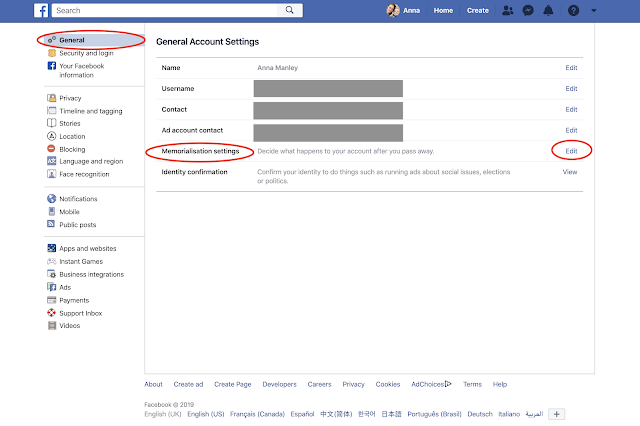
Step (3)
Enter in the name of someone you trust on your Facebook friends list. This person doesn't necessarily need to be your executor (if you have appointed one), but remember they will be the only one with access to your Facebook account after you pass away. Make sure it's someone who you trust to follow through on your wishes... also... tell them what your wishes actually are.
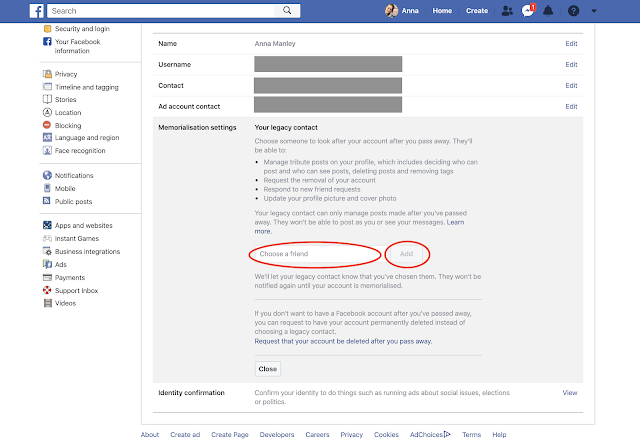
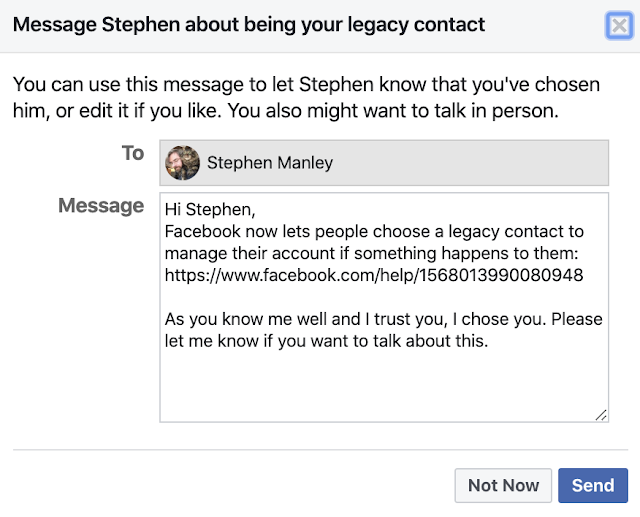
Once you select your legacy contact, a window will pop up where you can send them a message to let your legacy contact know that they've been appointed. I appointed my spouse, but you can appoint any person on your friends list. As with your executor, it's best to choose a person who will give effect to your wishes. You can even put those wishes in the message you send when you appoint them.
You can also select a yearly reminder settling where Facebook will automatically remind you who your legacy contact is and give you the option to change the friend who fills this roll.
Another option you can select on the "Memorialisation Settings" page. You can either allow your legacy contact to download what you have on Facebook. This is a good option to select because then your legacy contact can download all your photos in order to preserve them offline.

Overall, the Facebook legacy contact option is a necessary part of the estate planning process that occurs outside of your Will and other estate planning documents. For anybody with a digital presence, considering what is covered by your Will and what isn't is an important part of ensuring your most precious assets are safe for your family to cherish even after you're gone.
What is a digital legacy? For most Canadians that includes Facebook photos. I say Canadians because this is a Canadian blog, but also because Canadians love Facebook; 77% of Canadians have a Facebook account (compare that with 68% in the United States).
I personally have thousands of photos on Facebook; they chronicle important life events from my law school graduation to the birth of my first child. To say these photos are absolutely precious is an understatement. Losing these photos would be devastating, but imagine if I passed away and my family couldn't view or access them.

Unfortunately, even if you have a Will, Facebook will not allow your executor access to your account. There have been multiple, extremely sad news reports of families trying to gain access to a deceased person's Facebook account - all ending with Facebook refusing the request for privacy reasons. Facebook also has a contract with you via the user agreement you clicked to accept; this is a contract that dies when you do (pardon the pun). This means, your Facebook account (along with many other social media and other online accounts) are estate planning items that need to be handled outside of the traditional estate planning documents.
How do you do this?
With Facebook, you set a legacy contact on your Facebook account. A legacy contact is a person on your friends list who looks after your account if it's memorialized. An account changes to a memorialized account after Facebook becomes aware of your death (likely through your legacy contact).
A legacy contact can...
(1) accept friend requests on behalf of a memorialized account;
(2) pin a tribute post to the profile and change the profile picture and cover photo; and
(3) If your settings allow it, they can download account content (i.e. photos).
I've outlined the steps for doing on your browser below. The instructions are similar for mobile devices.
Step (1)
Go to your Facebook account settings. On mobile go to "Menu" and scroll down to "Settings & Privacy" - expand it and select "Settings".

Step (2)
Under "General" you should be able to see "Memorialisation Settings". Click on the "Edit" button. On mobile select "Personal Information" then select "Manage Account".

Step (3)
Enter in the name of someone you trust on your Facebook friends list. This person doesn't necessarily need to be your executor (if you have appointed one), but remember they will be the only one with access to your Facebook account after you pass away. Make sure it's someone who you trust to follow through on your wishes... also... tell them what your wishes actually are.

Once you select your legacy contact, a window will pop up where you can send them a message to let your legacy contact know that they've been appointed. I appointed my spouse, but you can appoint any person on your friends list. As with your executor, it's best to choose a person who will give effect to your wishes. You can even put those wishes in the message you send when you appoint them.

You can also select a yearly reminder settling where Facebook will automatically remind you who your legacy contact is and give you the option to change the friend who fills this roll.
Another option you can select on the "Memorialisation Settings" page. You can either allow your legacy contact to download what you have on Facebook. This is a good option to select because then your legacy contact can download all your photos in order to preserve them offline.

Overall, the Facebook legacy contact option is a necessary part of the estate planning process that occurs outside of your Will and other estate planning documents. For anybody with a digital presence, considering what is covered by your Will and what isn't is an important part of ensuring your most precious assets are safe for your family to cherish even after you're gone.
|
| This post was written by Anna Manley. If you'd like to contact Anna you can send her an email: anna@manleylaw.ca |
Whether you're a first time home buyer or this isn't your first rodeo, the process of buying a home can be intimidating. There's a lot of jargon and a lot of legalese, but the most daunting question of all is:
How much is this going to cost me?
Fair question. You've worked hard to save the money for a downpayment on a house - now it's time for you to take the plunge and you're worried about surprises.
To make the whole process a little bit less intimidating, we've broken down the fees associated with a real estate transaction (from the buyer's side) so you can have an idea of how much the whole deal will actually cost.
Let's handle this with a case study.
Buyers: Linda & Greg
Linda and Greg are a young couple who just moved back from Alberta to start a family in Cape Breton. They found a perfect house in Sydney River (for $200,000) and already have plans for a fence for the dogs. They've saved to buy the house and only need a mortgage for $75,000. Let's say, for the sake of this post, that there was no adjustment made to the original purchase price. Linda and Greg's fees on the transaction (on top of the purchase price) will be:
Deed Registration Fee ($100)
When you buy a property you receive a deed from the seller. It's your lawyer's job to register the deed on the parcel register (an online system for all things land and property in Nova Scotia); the province charges a fee of $100 for registering a deed.
Deed Transfer Tax (1.5% of the Purchase Price)
In the CBRM the deed transfer tax is 1.5%. This is money collected from your lawyer when your lawyer registers your deed. On a $200,000 purchase this would be $3,000. There are some exemptions to this, but that's for another post.
Mortgage Registration Fee ($100)
Just like registering the deed in the online system, the province charges a fee of $100 to register your mortgage. Registering the mortgage is the responsibility of your lawyer and is required by your lender as a condition of providing the money for the purchase.
Title Insurance (Starting at $200) or Survey (Starting at $1,000)
Your lawyer will also recommend obtaining either title insurance or a survey of your lot. Title insurance protects you from certain defects with your land which could arise after the sale. A survey is prepared by a qualified Nova Scotia Land Surveyor and (most of the time) is preferable to title insurance because you can deal with problems proactively, rather than after you've already purchased the land. Your lender will require either title insurance or a survey to make sure they're covered in the event the land is something other than what everyone thought.
Legal Fees ($900 to $1,200 + HST)
Of course there are legal fees and of course they range. They range based on the lawyer and on the nature of the transaction. Ultimately, it's best to find a lawyer who is experienced with property transactions and who is attentive to your needs. This is likely the biggest transaction of your life.
Here's the total breakdown for Linda and Greg:

If I were representing Linda and Greg in this transaction, I would contact them ahead of time to let them know the final amount I needed from them in order to close. In this case, that would be $129,830.00 ($204,830 minus $75,000 in mortgage funds). If they obtained a bigger mortgage with a smaller down-payment the picture would look a bit different.
As you can see, the fees for Linda and Greg add up to $4,830.00. Most of that is the $3,000.00 Deed Transfer Tax owing to the municipality. You can see how Linda and Greg, as new home buyers might be surprised by these fees. When it comes to finances it's good to be prepared, especially when you're buying a home.
If you're selling a home, the fees are very different. We'll cover the fees associate with the sale side of a real estate transaction in another post.
How much is this going to cost me?
Fair question. You've worked hard to save the money for a downpayment on a house - now it's time for you to take the plunge and you're worried about surprises.
To make the whole process a little bit less intimidating, we've broken down the fees associated with a real estate transaction (from the buyer's side) so you can have an idea of how much the whole deal will actually cost.
Let's handle this with a case study.
Buyers: Linda & Greg
 |
| Linda & Greg - aren't they cute. |
Deed Registration Fee ($100)
When you buy a property you receive a deed from the seller. It's your lawyer's job to register the deed on the parcel register (an online system for all things land and property in Nova Scotia); the province charges a fee of $100 for registering a deed.
Deed Transfer Tax (1.5% of the Purchase Price)
In the CBRM the deed transfer tax is 1.5%. This is money collected from your lawyer when your lawyer registers your deed. On a $200,000 purchase this would be $3,000. There are some exemptions to this, but that's for another post.
Mortgage Registration Fee ($100)
Just like registering the deed in the online system, the province charges a fee of $100 to register your mortgage. Registering the mortgage is the responsibility of your lawyer and is required by your lender as a condition of providing the money for the purchase.
Title Insurance (Starting at $200) or Survey (Starting at $1,000)
Your lawyer will also recommend obtaining either title insurance or a survey of your lot. Title insurance protects you from certain defects with your land which could arise after the sale. A survey is prepared by a qualified Nova Scotia Land Surveyor and (most of the time) is preferable to title insurance because you can deal with problems proactively, rather than after you've already purchased the land. Your lender will require either title insurance or a survey to make sure they're covered in the event the land is something other than what everyone thought.
Legal Fees ($900 to $1,200 + HST)
Of course there are legal fees and of course they range. They range based on the lawyer and on the nature of the transaction. Ultimately, it's best to find a lawyer who is experienced with property transactions and who is attentive to your needs. This is likely the biggest transaction of your life.
Here's the total breakdown for Linda and Greg:

If I were representing Linda and Greg in this transaction, I would contact them ahead of time to let them know the final amount I needed from them in order to close. In this case, that would be $129,830.00 ($204,830 minus $75,000 in mortgage funds). If they obtained a bigger mortgage with a smaller down-payment the picture would look a bit different.
As you can see, the fees for Linda and Greg add up to $4,830.00. Most of that is the $3,000.00 Deed Transfer Tax owing to the municipality. You can see how Linda and Greg, as new home buyers might be surprised by these fees. When it comes to finances it's good to be prepared, especially when you're buying a home.
If you're selling a home, the fees are very different. We'll cover the fees associate with the sale side of a real estate transaction in another post.
|
| This post was written by Anna Manley. If you'd like to contact Anna you can send her an email: anna@manleylaw.ca |

Regardless of the size of your estate, the person you choose as your executor is going to have their work cut out of them.
It's the responsibility of the executor to deal with your estate assets in accordance with your will. In order to deal with those assets, your executor needs to be able to find them. It can be hard for executors to find assets like insurance policies or shares if you don't have the paperwork in one place at the time of your death. Finding estate assets after an estate has been dealt with can also add unnecessary time and expense to the handling of your affairs.
Rather than send your executor on a treasure hunt for your estate assets, you can take steps to make their job easier by keeping and updated list of your assets along side your will and other estate planning documents.

Remember, just like your will, the information inside the Estate Workbook is sensitive financial information and should be treated (and stored) with the utmost care. Keep the Estate Workbook in the same safe place you store your will and other estate planning documents.
Download and complete our Estate Workbook to make your executor's job easier.
|
| This post was written by Anna Manley. If you'd like to contact Anna you can send her an email: anna@manleylaw.ca |

CB Voices is a group of women stakeholders in Cape Breton Island. They believe in encouraging economic growth through fostering business, entrepreneurship, immigration, arts and culture, and tourism.
As part of their work, they created a series of videos called Women in Entrepreneurship. They interviewed female business owners from across the island in diverse sectors on their businesses and the how entrepreneurs can make a difference in the economy.
I was honoured to be included in the series along the outstanding female entrepreneurs. I was in good company and I encourage you to watch the interviews of all the other fantastic women - these are the people who are making a difference on our island.
I've posted my video below so you can hear what I had to say about my business, women in law, women in entrepreneurship, and the cultural shift happening on the island toward entrepreneurship.
Bonus: one of our office cats is featured.
Enjoy!
|
| This post was written by Anna Manley. If you'd like to contact Anna you can send her an email: anna@manleylaw.ca |


